Showing posts with label Recent Books. Show all posts

Thursday, April 11, 2013

Let me Clear my Throat by Elena Pasarello - Review


A marvelous read all the way through, Elena Passarello’s first book, Let Me Clear My Throat is a charming and enlightening read all the way through.  The book comprises a series of short essays on the human voice, its limits, failings, and potential to soar. Each essay is well placed and contains a variety of thoroughly well researched essays on the subject of voice and what it means

"The voice of war  can turn gossip into
nicknames, dialogue into mythology."
The book is divided into three sections, Screaming Memes, Tips on Popular Singing, and The Thrown.   Screaming Memes goes into subjects such as the Wilhelm Scream, the Rebel Yell, and the "BYAH" that ended Howard Dean’s presidential race.  I’ll admit this first section was my favorite, particularly the last chapter, Harpy, which details Passarello’s loss of voice that drove her to victory at the Stella Screaming Competition, viewable here.  The essay is the first personal essay in the book, and feels very intimate.  We really understand where Passarello is coming from, and after all this radiant description of the human voice that she cares so much about, the idea of someone losing theirs seems repugnant.

Tips on Popular Singing’s “Space Oddity” delivers possibly the best possible commentary on the launch of the Golden Record on the Voyager Probe:

"Once the Voyager Probe was loaded with telemetry modulation units and spectrometers, we then made the decision to attach human voices to the contraption's flanks. And we added not just the voices of our leaders, but singing voices, including [Chuck Berry's "Johnny B Goode."] This is what beats out speeches and formulae and IBM The Ring Cycle.  According to NASA and Carl Sagan (and me) this is what the universe wants to hear.
Which is another way of saying that we have more faith in popular music than anything else on the planet."

Her insights into various popular singers, from the rise and fall of the Castrati to Judy Garland to the crows outside her window paint a vibrant portrait of music over the years, and had me scrambling to update my iTunes with an impressive variety of music.

The Thrown is a bit harder to summarize.  I suppose you could say it’s simply meditations on the human voice, what it means to us and why it matters so much to Passarello. This section is more freeform, and more fascinating for it.  It’s conclusion, an account of a Ventriloquist Dummy’s search for a voice all its own, is surreal and insightful all at once. 

Passarello impresses me by pulling off that trick that made me fall in love with Up Jumps the Devil, the trick of compressing sound into words.  From a scream that “Cuts a big yellow gash in the air” to an ‘Eew’ that skips out perfectly like a smooth stone across the audience, the visual, textural feeling of sound comes through magnificently.  I definitely advise reading this book with a computer handy, so you can listen to each song Passarello mentions, so that you can have the experience of nodding, as you read her words, and say “Yes.  Yes, those words are exactly the right ones for what I’m hearing.” 

Thursday, March 14, 2013

The Lost Episodes of Revie Bryson by Bryan Furuness - Review


A woman makes up stories of the Devil's dad painting his portrait.1  A man has the idea for an indoor golf course.  A substitute-teacher goes to a rough-and-tumble cafĂ© and for the polka music.  An Ordinary Boy realizes that he simply must be the Second Coming2.  The Lost Episodes of Revie Bryson, the new book from Bryan Furuness perfectly captures that area of Northern Indiana known as “The Region,” with its feeling of empty space and jittery doldrum, where the mantra seems to be “Bizarre is better than boring.” 

The Golfdome is a primary set piece because even nature
cannot stop a hoosier from golfing.
In the story, young Revie Bryson’s life is shaken to pieces when his mother, who makes up “Lost Episodes” from the Bible, leaves one day to go be a movie star.3  The stretches over the following year as he and his father have to learn to cope with the change.  At times hilarious, at times tragic, the Lost Episodes brings us into Revie’s world.  As he grows far faster than any twelve-year old should, we see the people around him change even as the country utterly fails to. 

Furuness captures The Region4 with documentary precision.  I’ve been to the Region, I’ve smelled its air, and it smells just like the words in Furuness’s book.  I’ve been baffled by how fast children grow up there, how fast they have to.  Revie is a perfect example of this.  As the focus of the book, Revie is wonderfully genuine.   His antics to sabotage his father’s diet, his escapade with the camels, his attempts to manipulate his parents back into a relationship all had me going yeah, that’s how a kid from the Region would act. 

Burried in the fiction (which reads so much like memoir I had to keep reminding myself it was not, a la
"The universe is like a Toilet: everything swirls together
faster and faster in the end."
Towelhead)5 is quite a lot of philosophical introspection, especially on the nature of the universe, people, and religion.  The book makes no firm stance on faith, but does a good job portraying the faithful, from the priest who recurs as a sounding board for Revie’s emotions to his Grandmother, whose imperious palm reading was either dead on or way off.  How you call it says more about you than the character.6

If you’re from Indiana, especially The Region, this book is probably something you’d enjoy.  It's down-to-concrete tone gives you that feeling like getting in touch with an old friend and/or your inner self.  Alternatively if you’re from Florida, or California, or New York, or other places that only exist in the movies, but you like novels about local people doing local things and local…people7, this is also a good read.  Go pick it up.

"Anything that has Mass exerts Gravity.  You have mass, right?"
"I'm a Presbyterian."

Wednesday, February 6, 2013

Tolkien-Pulp: A review of Wytchfire by Michael Meyerhoffer

So I just finished reading/livetweeting Wytchfire by Michael Meyerhoffer.2  I'm not going to lie, when I was googling the book, I was somewhat hesitant, skeptical.  There's this section at any bookstore just labeled "Sci-fi/Fantasy" where all the books seem to be the same, and you kinda feel like not reading them as quickly as possible.  There's a certain ghetto happening here, the Sci-fi/Fantasy ghetto at it's worst.  Sure, there's fantasy out there that gets popular enough to rise above the ghetto, but they seem often few and far between.  It's not a genre people take seriously, mostly because people assume there's no inherent worth.  It probably also has to do with the cultural ostracization of D&D, and all of its trappings, into the "Other" category.  The "Standard D&D universe" has, thanks mostly to Tolkien3, been so thoroughly ingrained in the cultural consciousness that most people can tell you the rules without having actually read a high-fantasy pulp book.
I actually know who all these characters are and what
they're doing.  #Dragonlance.

Everyone knows that Dwarves are stout and beardy, Elves are pretty and magical and live in forests, Knights are noble and always do the right thing, magic comes at a price, and the orphan stableboy turns out to be the long lost heir of the kingdom.  The Undead or Dragons show up to cause problems and the hero saves the day and no one points out that he should probably be dead from all the diseases that would come of fighting shambling undead, or burned to a crisp from Dragon fire.  And that's 1st Wave Tolkien-Pulp.

This persisted for a while until people started subverting those tropes, until 1st Wave Tolkien Pulp became ghettoized even by its target audience.  In came Pratchett and Anthony and Jones, who were masters of subverting the tropes and making things very self aware and funny and that was what people started to read, because a good parody makes the reader feel clever because she4 gets the joke, and slowly but surely Parody killed the Fantasy Pulp Star.  And that was 2nd Wave Tolkien-Pulp.

Most5 of the Tolkien-Pulp on my shelves is 2nd Wave.  It's easier, more accessible, and more fun.  It's been a long time since I've read some good, solid, down to Erathia Earth 1st Wave Tolkien-Pulp.  And that's what Wytchfire is, on the surface, so when I heard Meyerhoffer was looking for readers I did so more out of duty than excitement.

But then I really started reading.

Wednesday, January 30, 2013

The Last Policeman by Ben H Winters - Review

I figured out how I can make footnotes work!  Having the numbers be a mouse-over works a lot better than linking to a footnote at the bottom, the HTML doesn't like me.  Also, I've started doing spoilers in white, if you don't care about spoilers highlight to read. 

Tracks for this Evening: Love 2012, The main theme from Melancholia, Everything is Ending, Until the End of the World, some zYnthetic, take your pick.  Oh, and while it doesn't fit the mood, I think everyone should listen to this at least once.  

Man, I love me some good detective fiction.  There’s just something thoroughly compelling about someone pounding the streets and using nothing more than his wits and charisma to get answers out of people who only sorta have to answer.  Thing is, in the words of Miss Mazeppa1, you’ve gotta get a gimmick.  Eg, the detective is a sweet old lady2, or a medieval monk3, or it’s set in England during the War Years4.  And what’s a better gimmick than the apocalypse? 

Our Primary Antagonist for the series will be measured in
Astronomical Units away. 
That’s where this week’s book comes in.  Written by Ben H. Winters, The Last Policeman tells the story of a policeman solving a murder as the world prepares to end.  A few months ago, the world got the bad news:  Asteroid 2011GV1, Maia, is hurtling towards the planet and there’s nothing that’s gonna stop it.  And so the human race threw up its hands and cursed the sky, and society started to crumble.  

Thursday, January 24, 2013

Up Jumped The Devil by Michael Poore - Review


Tracks for the Evening: Up Jumped the Devil, Cry Little Sister, People of the South Wind, maybe a little bit of this cover of "Crossroad Blues".  Also, quite a bit of this.  Warning, light spoilers.

It’s the car that really won it for me. 

To explain:  In Michael Poore’s new rapscallion of a novel Up Jumps the Devil[1], the Devil is the classic, deal making, guitar playing, crossroads meeting Devil.  He’s got all the evil you’d expect of, well, the first person ever to shake a fist at the Lord God Almighty.  But he does bad with such style.  He smokes most things in the book.  He has sleazy love-affairs on live TV with Not!Miley Cyrus.  And he drives a Midnight Blue 1961 Lincoln Continental.
It's the one in front.
See, it’s easy to write an evil character.  You give him some puppies to kick, give her some orphans to smack, it’s easy.  What’s hard is writing fun, creative evil.  That said, Michael Poore’s Devil isn’t all that evil.  He’s not even sinister.  It’s more that he’s just very Chaotic Neutral[2].  He gives no real care to issues of ‘good’ and ‘evil,’ but more to things like ‘this is fun’ or ‘that guy’s an asshole.’  It’s a rather Blue-and-Orange Morality, and it does a great job of making the Devil a likable character.  But he’s also fairly deep too.  There’s a heavy undercurrent of sadness in him, a world weariness.  And quite a lot of anger.  After all, “he got kicked out of HEavEN! And had his true love stolen by GOD! And his true love had let him four different times and he hadn’t seen her for three hundred YEARS!”

Thursday, January 17, 2013

Cold Days, and its Unintentional Stoicism


Warning:  This essay contains Spoilers for Cold Days: A Novel of the Dresden Files[1]by Jim Butcher.  While the dramatic conclusion is left unrevealed, I would advise buying and reading first.  Note, this is Book 14 of an Ongoing Series, so it may take some time to get there, but believe me the journey is worth it for the intricate, immersive and at once grim and riotously funny world that Butcher crafts.

When one hears the word “Stoic”, one’s first thought is of calm, rational, unmoved thinking, something like this:
He comes up if you Google "Stoic"
However, the old term was a bit more complicated.  It did stress the rational calm of our modern conception of the word, but it also had a certain element of fatalistic determinism to it.  The Stoics Philosophy can be summed up thusly: “Virtue consists in a Will that is in agreement with Nature.”[2]  For the Stoics, a person had a certain role to play, certain actions they were bound to undertake in any situation, and certain fates that were bound to befall them, and happiness came from accepting that fact.  Later stoics took it a step further, for them if you acted without great passion you would never find yourself in unfortunate circumstances. 

This does not seem like a philosophical standpoint that would relate to Harry Blackstone Copperfield Dresden, Protagonist of The Dresden Files, the man who answers insults with conjured conflagration, who will leap directly into the path of danger because a lady is in trouble[3] and who once started narration with “The Building was on fire and it wasn’t my fault.”[4]


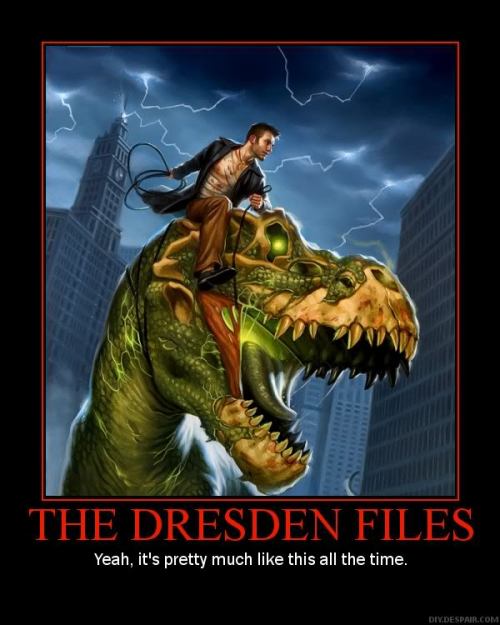
The Zombie T-Rex powered by Polka
makes perfect sense in context. 
However, while the main character of the series is about as stoic as Spock is emotionally driven, the series as a whole has become extremely Stoicist in its philosophies, particularly in the most recent book in the series, Cold Days.