Thursday, April 18, 2013

Game of Thrones vs. Vikings


Game of Thrones is currently the biggest Juggernaut on air.  It’s got massive backing, a rabid fanbase, and it’s the most illegally downloaded show out there.  This is all while being on HBO, which you have to pay to watch. 

Meanwhile, Vikings is on the History Channel and sorta slides in after The Bible because the History Channel doesn't want to come down solidly on one side of religion or the other.

Why am I comparing them?  Well, partially because presenting at the East Central Indiana Social Media Group took a lot of time out of reading time this week, partially because a lot of people are going to anyway.  It’s like Buffy and Charmed, you can’t NOT compare them, even if you don’t want to.

Both shows are historical dramas in the dung ages and focus on kings, battles, religion, and morally grey characters.  They’re visually similar, both having a Grey Filter for a lot of shots.  They both have actors you've probably seen somewhere else.

So, which is better?  Let’s find out.  I’ll split this into four categories: Characters, Story, Addiction, and The Prestige.
"I'm not questioning your honor, Lord Janos. I'm denying its existence."
Character:
If we go in terms of quantity, Game of Thrones has more.  Dear gods, Game of Thrones has more.  Tyrion, Arya, John Snow, Robb, Lady Stark, Daenerys Targaryen, Stannis Baratheon, Theon Greyjoy, Sam, and that’s just the main characters.  I probably forgot some.  Each has their own individual plotlines. 

Tyrion
★★★★★
Arya
★★★★★
John Snow
★★
Robb Stark
★★
Lady Stark
★★
Daenerys
★★★★
Stannis
Theon
Sam
★★★★
Average:
★★★
Meanwhile, Vikings is more focused on Ragnar, the guile-hero, who’s clearly the main character, but his Nakama definitely gets their own screen time.  Athelstan, Lagertha, Rollo, Floki, Ragnar’s kids, even some of the villains get their own arcs.  The characters aren’t all as likeable, and only one is female, but since there’s LESS of them we get to know them much better.  It’s hard to judge characters, so I’ll give them stars out of five for how interested I am in their arc.

Ragnar
★★★★
Lagertha
★★★★★
Rollo
★★★★
Floki
★★★★
Athelstan
★★★★★
Earl Haraldson
★★★
Average:
★★★★
While I care a lot about Tyrion, Arya and Daenerys, because funny, cool and dragons, respectively, the Starks don’t interest me much and I’m ready for Theon and Stannis to just go away.  Sam is only interesting because I’ve heard he does cool things in like, three books from now.
Meanwhile, I’m really interested in all of the focus characters from Vikings, because they all raise interesting questions.  I’m most excited about Athelstan, because he’s questioning his religion and it’s fascinating to watch it play out.  Point to Vikings.

"We're going to see Floki."
"Like the Mad God?"
"Not exactly."
"How's he different?"
"...he's not a god."

Plot
Second verse, same as the first.  Game of Thrones has approximately ALL of the plots.  John Snow is up north getting involved with the wildlings who are marshaling for war with the White Walkers who are chasing Sam to the Wall which is north of the ruins of Winterfell where the Starks lived until they started waging war to rescue their sisters who are captives of oh gods no.  If you really want to know, watch the show or watch this video.

Meanwhile, Vikings has a few plots, most of them subtle things (Rollo trying to become Earl, Athelstan’s conversion) but most things center around Ragnar’s progression from nobody to hero to outcast to Earl to…who knows what, and his conflict with Earl Haraldson. 

That said, Vikings has a fairly simple plot, whereas Game of Thrones has…all of the plots (no really, all of them) and still manages to tell good stories.  It takes a long time, but they CAN make the plots work, even if it’ll be about four years before they actually resolve most of them. That said, each season some of the plots do get resolved satisfyingly.  And I’ll admit, I’m more interested in seeing what happens to all the characters in Game of Thrones because, well, Dragons vs. Sorcerers vs. Zombies vs. Armies vs. Shapeshifters vs. Tyrion Lannister  So, in the end, Point to Game of Thrones.
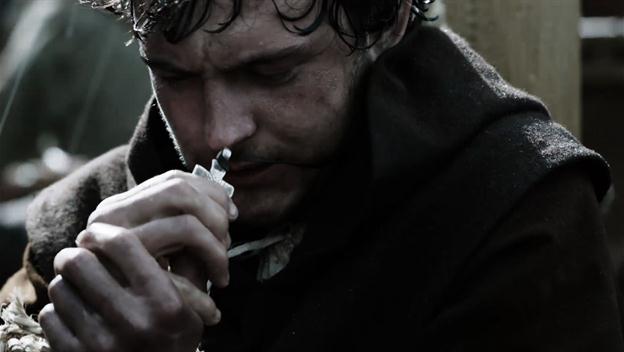
Athelstan: "There is a time to sow, a time to reap. A time to
heal and...and a time to kill."
Ragnar: "Sometimes your God sounds like one of ours."
Addictivity
This comes down to which do I want to watch more as the weeks go on.  As it stands, I want to watch Vikings more, every time.  You’d think Game of Thrones, because of all the cliffhangers, but no.  That’s the trouble with having nine (or more, hell, I totally forgot Sansa and Jeoffry) characters to keep track of, half of them will be in peril at the end of the episode INEVITABLY.  (Oh and also Bran, he’s got a separate plotline too.  Christ!)  Because I know there’s going to be a cliffhanger and probably no satisfying ending, and because I’ll often forget which of four cliffhangers happened first. 

Meanwhile with Vikings, each episode ends with either a single cliffhanger or with conflicts mounting, but having a stasis, however uneasy, at the end of each episode.  Also, the character development is slow and interesting, and I want to see how things will change and if there’ll be a big payoff.  I’ve mentioned Athelstan the Monk.  Ragnar’s slave, friend, and almost lover, he has a fascinating and slow building arc towards possibly converting from Christianity to Paganism.  It’s fascinating and treated with subtlety, and they show a lot of reasons why he would apart from just loneliness and separation from others of his own faith.  Right now, that’s what I most want to see played out over the week.  So, point to Vikings.

"There is one thign we say to Death:
'Not Today.'"
The Prestige
The Prestige is which show delivers the goods.  Essentially it’s judging which exotic dancer manages to flash its gussets better.  While on the Point to Game of Thrones.

Sorry, Vikings.  I love you, but you don’t have Dragons or Zomibes.  And while I’m delighted by your frequent use of the mythology I hold most dear, there’s still only so much you’re going to do on a lesser budget with only so many characters.  That said, Vikings is quite enjoyable to watch, both in terms of visuals and story.  I’m always glad to see what Floki is up to, and I need more Lagertha like I need my shower in the morning.

But in the end, Game of Thrones is more magnificent and will probably last longer.  It’s also more memetic.  You see “House Lannister” shirts all over the place, or shirts with a squid that read “We do not Sow” and I’ve heard my neighbors shouting “THE KING IN THE NORTH!” at all hours of the night.  So, this Point goes to Game of Thrones.

As you’ve noticed, now the points are even.  In the end, they’re both great shows.  Vikings is personal and fun, whereas Game of Thrones is big and Epic and Flashy.  Both deliver different things and have different reasons to exist.  I’d say watch both of them, you’ve got nothing to lose.  But if you have to choose which to watch as it airs, watch Vikings, because it needs viewers.  Even if it does have a second season.  

Thursday, April 11, 2013

Let me Clear my Throat by Elena Pasarello - Review


A marvelous read all the way through, Elena Passarello’s first book, Let Me Clear My Throat is a charming and enlightening read all the way through.  The book comprises a series of short essays on the human voice, its limits, failings, and potential to soar. Each essay is well placed and contains a variety of thoroughly well researched essays on the subject of voice and what it means

"The voice of war  can turn gossip into
nicknames, dialogue into mythology."
The book is divided into three sections, Screaming Memes, Tips on Popular Singing, and The Thrown.   Screaming Memes goes into subjects such as the Wilhelm Scream, the Rebel Yell, and the "BYAH" that ended Howard Dean’s presidential race.  I’ll admit this first section was my favorite, particularly the last chapter, Harpy, which details Passarello’s loss of voice that drove her to victory at the Stella Screaming Competition, viewable here.  The essay is the first personal essay in the book, and feels very intimate.  We really understand where Passarello is coming from, and after all this radiant description of the human voice that she cares so much about, the idea of someone losing theirs seems repugnant.

Tips on Popular Singing’s “Space Oddity” delivers possibly the best possible commentary on the launch of the Golden Record on the Voyager Probe:

"Once the Voyager Probe was loaded with telemetry modulation units and spectrometers, we then made the decision to attach human voices to the contraption's flanks. And we added not just the voices of our leaders, but singing voices, including [Chuck Berry's "Johnny B Goode."] This is what beats out speeches and formulae and IBM The Ring Cycle.  According to NASA and Carl Sagan (and me) this is what the universe wants to hear.
Which is another way of saying that we have more faith in popular music than anything else on the planet."

Her insights into various popular singers, from the rise and fall of the Castrati to Judy Garland to the crows outside her window paint a vibrant portrait of music over the years, and had me scrambling to update my iTunes with an impressive variety of music.

The Thrown is a bit harder to summarize.  I suppose you could say it’s simply meditations on the human voice, what it means to us and why it matters so much to Passarello. This section is more freeform, and more fascinating for it.  It’s conclusion, an account of a Ventriloquist Dummy’s search for a voice all its own, is surreal and insightful all at once. 

Passarello impresses me by pulling off that trick that made me fall in love with Up Jumps the Devil, the trick of compressing sound into words.  From a scream that “Cuts a big yellow gash in the air” to an ‘Eew’ that skips out perfectly like a smooth stone across the audience, the visual, textural feeling of sound comes through magnificently.  I definitely advise reading this book with a computer handy, so you can listen to each song Passarello mentions, so that you can have the experience of nodding, as you read her words, and say “Yes.  Yes, those words are exactly the right ones for what I’m hearing.” 

Thursday, April 4, 2013

The DM's Notebook: Using D&D for Creative Writing: ~Publishing and Skill DCs~


So I've been thinking for a while about the way the Dungeons and Dragons RPG, in its trappings and mechanics, has some really useful applications for Creative Writing.  The Dungeon Master's Notebook is a series of  to organize such thoughts. 


Dungeon Master's Notebook: Publishing and Skill DCs


This week over in Literary Citizenship we’re writing Query Letters, and in Screenwriting we’re discussing genre.  Near as I can suss it, it's easier to get things published when your story has less StuffStuff, here defined as ‘things that deviate from the norm,’ includes Superpowers, Aliens, Different Time Periods, GLBT Romance, and many other things.  Getting something published with Stuff is much harder than a work without Stuff.  It’s a bit like a skill’s DC.

DC, in Dungeons and Dragons, means the Difficulty Challenge.  There's a different DC for every Skill.  (Climbing, Crafting Potions, Linguistics, etc) and a player must roll1 to surpass the challenge.  Say it’s a Perception Challenge.  A character rolls to see if they can hear a bow being drawn in the forest.  The DC is 25.  Two players roll, add skill ranks, and get a 27 and a 31.  The third only gets a 17, and fails to hear the bow. 

Conditional Modifiers
DC
Through a closed door
+5
Roaring Tempest
+2
Target is invisible
+20
Creature making the check is asleep
+10
Now, DC 25 is under normal conditions.  Say that there’s a battle raging.  The DC goes up by +1 per 10 feet away.   It goes up by +10 for every foot of Wall in the way.  That seems to be how it works in publishing, the more Stuff, the more the DC goes up.


Say you’re submitting your story to QuirkyUnafiliatedIndependentPress (QUIP) and SeriousLiteraryUniversallyRespectedPress (SLURP).  Now, QUIP likes a lot of stuff, but they’re not well known.  The base DC is only about 14.  Any sufficiently mid-level writer can make that DC.   But SLURP is harder to get into, because they’re very prestigious.  That DC is 25, fairly high.  You’d have to roll well AND be pretty high level.   But wait!

Let’s say your story is about a man in a polyamorous triad who dies and comes back as a ghost to take care of the child his girlfriend is having while helping his girlfriend and boyfriend fix their relationship.2  The DC goes up, because your story has the following Stuff.

Stuff          
DC
Heavy GLBT themes
+1
Polyamory
+2
Ghosts
+5

Now the DCs are 22 for QUIP and a rather high 33 for SLURP.  However, QUIP likes weird, genre-queer stories.  The DC only goes up by half for the Ghost, and doesn’t change at all because QUIP is run by sufficiently advanced liberals.  The DC to get your story into QUIP is only 18.  A good cover letter and writing talent and boom, they publish your ghost story.3

The trick to getting published is finding somewhere with a baseline DC you think you can beat and giving them something that doesn’t raise the DC too much.  (Although, it still has to be a good story. That's probably the most important thing for writing.  You have to be able to write.)

Previous Notes: Ability Scores, Random Encounter Tables

Thursday, March 28, 2013

7 Things to Bring when Trying to Get Published

This week my Literary Citizenship class is talking about Publishing A Book, and our challenge is to write what we've learned from our homework. A bunch of it is in the links over here on Literary Citizenship.com, under Publishing a Book 101. Also, check out some of my classmates blogs: Sarah's, Kayla's, John Carter's, Mike'sKiley's, and Lindsey's.  

I keep thinking of the author as a traveler, with different tools in their bag that will help them along the way.  As far as I understand, these are such tools as an Author needs:

1 - The Manuscript and Errata
Your manuscript is important.  Don't send it out until it's ready to be published.  But have offerings for the Agents.  A Proposal, with a synopsis, a query letter, a perfectly polished chapter.  Pluck is great, preparation is better.  Make sure the Agent knows the book's genre and cool factor, how it would appeal to people, who those people are, and be ready to tell an Agent how it ends.

2 - The Grappling Hook
When talking to an Agent, you're not going to get picked at first.  It's like a grappling hook, you can throw it but if you don't find a niche for it to grab it won't hold. That's cool.  Pull it down, aim somewhere else, and throw again.  Eventually you'll find some way to scramble up the cliff face.  It helps if you have something (like the Bishop's Ring, or The Leg) under your belt.

3 - The Bishop's Ring
No matter how good you are as a writer (or in this metaphor, an intrepid detective), it helps to have something to get noticed.  In ye olden days you could show  the bishop's signet ring to someone to make them sit up and take notice.  Nowadays, it's a Namedrop, but it works the same way.  Being able to namedrop someone of note to the Agent will mean you're connected in the web.  The Agent takes interest, you get five more minutes.

4 - The Leg
An Agent wants to be seduced by a proposal.  Show a little leg, just enough to entice.  A paragraph.  Half a page. The less you show, the more the the author will want to know.  As long as it looks good, the rest must be good, and now there is so much more to discover!  Give an Agent too much and they won't have time for it.

5 - Self Awareness
In one of our readings there was an exhaustive Author Questionnaire from Simon and Schuster covering everything from basics (Author's name, address) to inquisitive (religion, business affiliations) to oddly specific (do you shop at Costco's, Sam's, or BJ's?)  I took from this that it's important to know yourself and to be willing to share  your biography.  Also, if you want to publish, now would be a good time to be the sort of person who gets published.

6 - Thy Friends
In my notes I keep writing the reminder, "You are Not Alone."  Not only do you have help publishing (From agents, editors, the various people who work at the publishing house who have the job of advertising) but the people you've known or helped along the way.  Other authors you've supported, fellow students, old friends with connections at that local library.  These are people who can point you to the places you need to go, and can help tell people about your book once it's in the pipeline, or yammer about it on Goodreads.  Related, Goodreads Explained.

7 - The Clouds
Just as a vagabond knows how to watch the clouds for rain, or strong winds, someone getting published should watch The Cloud for trends, emerging markets, new players, lightning flashes that might draw people from all around, where you can share directions, news, helpful herbs.  Right now two big thunderheads are rolling in:  Small Press and Independent Publishing.  Both will blast trees to pieces with a thunderclap, both will enrich the soil and new things will grow, whether or not we want them to.

There's a lot more a person needs. Time, Tenacity, Ingenuity, money helps too.  And as I learned at In-Print last week, the road to publication is rarely straight, there are bound to be lots of twists and curves.  It's more about keeping up with the journey.  


Wednesday, March 20, 2013

In Print Festival of First Books


There’s a silence that comes with writing.  The problem is that so many of us spend so much time trying to find the perfect word, the word made from diamond and moonlight, and put it in its perfect place in its sentence.  But there isn’t that time in the world, so fast and so hungry, to find those perfect words, but we don’t know how not to.  And thus cobwebs form in our throats, little spiders hatched from disuse and imperfection.  So how then do writers tell the world that there is magic happening?
The writers, up close and personal,
so happy to talk to students.  Such
nice people.
With the printed word of course.  Writers will do anything for the sake of words already formed, words already put down.  Writers will walk through snow, into bars we’ve never entered and down streets we’ve never walked to hang posters all over, telling the world “Come, please, there’s magic here, syllables that cascade out of stardust and paint bliss across your ears!” 

This week was the 8th Annual InPrint Festival of 1st Books.   In acquiesce1  to a bit of mandate from Cathy Day I indulged my curiosity to see if our advertisements were worth it.  I went up to the throng of guests asking everyone “Hi!  Why are you here?”2  The first night was a thoroughly dissatisfying commiseration of “I’m here for class, I’m here for class, I’m here for Cathy Day’s 307, I’m here for my 104, I’m here because I need to graduate and this requires no commitment.”

A few though, like Brett, whose hair is still not grown back from when he cut it early this year, came because they “Just like these things” and by heaven it was a relief, he was the first who came just to come.  There were more like him, more literary citizens, quiet but present, fluttering like moths to the fires of their choosing.3   There were another smattering who came for The Broken Plate,4 which came wearing its new wine dark lipstick of a publication, skirt pulled back, ankle bare, and it was a buffer, a book-end, its table opposite the writers as if to say “This place between word and sound is for you, you have come into the garden.  Here you are safe."

"If you go on this...pilgrimage to Prairie Lights, they will
BUY YOU COFFEE AND CRUMPETS." 
And the writers were magnificent.  That first night there was Elena Passarello, who made us laugh and smile as she transfixed us with a dead woman’s voice.  There was Marcus Wicker, whose poems had punch line titles and punch gut conclusions.  There was Eugene Cross, whose smile is a giddy puppy and whose writing is vivid and sharp and sad, maybe the saddest thing5 I’ve read in months. 

The audience raised spirits the second day.  While the first night was a “The Place was packed” sort of night, now on the second night it had dropped to just “A lot of people came.”6   BUT, the people who did come had less of this “I’m here for class,” more of this “I’m here for fun” OR “I’m here for Extra Credit” which is important because they still CHOSE to come, AND people who come for extra credit care enough about the thing for that credit.  They care, they just don’t know how to show it yet.  And then of course there were those who came because they wanted to support the poets, who’d been to every InPrint Festival since its inception, who praised the group’s dynamic and the advertisements that they’d seen, and I swelled with pride that someone, anyone, had noticed the work.

That happy moment when more people came back because they chose to.
The panel of the three writers who read the night before was joined by Sarah M Wells, an editor with a snappy personality who's somehow still alive despite doing everything in the world; writing, publishing, editing, mothering.  A human thunderstorm.  Their answers to questions showed me something vital: That Abyss between us and Published Writers is not so vast, is a matter of words.  They are not gods, or if they are, so too someday might we be.  Audience members praised their dynamic, the excitement and honesty of them, the way they made the room come alive.

Everyone wanted an autographed book and every author was so delighted to talk to people that we ran delightfully over time and had to be hurried out by the management. 
The conversation that had the most resonance to me was with Guy With Camera, who’d filmed the whole thing for a TCOM class.  I asked him, “What brings you here?” and he said that he was here for a class, “but I do some writing too”.  There was some defensiveness in it, but also some aspiration, some acknowledgement that here, in this room, books and writing are the hippest things imaginable.  It made me smile, let me clear my throat7 of the last of the cobwebs, let me rave and ramble about all this to my roommates when I got home, with no fear of imperfect words because there were enough of those today to last a lifetime.

Thursday, March 14, 2013

The Lost Episodes of Revie Bryson by Bryan Furuness - Review


A woman makes up stories of the Devil's dad painting his portrait.1  A man has the idea for an indoor golf course.  A substitute-teacher goes to a rough-and-tumble café and for the polka music.  An Ordinary Boy realizes that he simply must be the Second Coming2.  The Lost Episodes of Revie Bryson, the new book from Bryan Furuness perfectly captures that area of Northern Indiana known as “The Region,” with its feeling of empty space and jittery doldrum, where the mantra seems to be “Bizarre is better than boring.” 

The Golfdome is a primary set piece because even nature
cannot stop a hoosier from golfing.
In the story, young Revie Bryson’s life is shaken to pieces when his mother, who makes up “Lost Episodes” from the Bible, leaves one day to go be a movie star.3  The stretches over the following year as he and his father have to learn to cope with the change.  At times hilarious, at times tragic, the Lost Episodes brings us into Revie’s world.  As he grows far faster than any twelve-year old should, we see the people around him change even as the country utterly fails to. 

Furuness captures The Region4 with documentary precision.  I’ve been to the Region, I’ve smelled its air, and it smells just like the words in Furuness’s book.  I’ve been baffled by how fast children grow up there, how fast they have to.  Revie is a perfect example of this.  As the focus of the book, Revie is wonderfully genuine.   His antics to sabotage his father’s diet, his escapade with the camels, his attempts to manipulate his parents back into a relationship all had me going yeah, that’s how a kid from the Region would act

Burried in the fiction (which reads so much like memoir I had to keep reminding myself it was not, a la
"The universe is like a Toilet: everything swirls together
faster and faster in the end."
Towelhead)5 is quite a lot of philosophical introspection, especially on the nature of the universe, people, and religion.  The book makes no firm stance on faith, but does a good job portraying the faithful, from the priest who recurs as a sounding board for Revie’s emotions to his Grandmother, whose imperious palm reading was either dead on or way off.  How you call it says more about you than the character.6

If you’re from Indiana, especially The Region, this book is probably something you’d enjoy.  It's down-to-concrete tone gives you that feeling like getting in touch with an old friend and/or your inner self.  Alternatively if you’re from Florida, or California, or New York, or other places that only exist in the movies, but you like novels about local people doing local things and local…people7, this is also a good read.  Go pick it up.

"Anything that has Mass exerts Gravity.  You have mass, right?"
"I'm a Presbyterian."

Thursday, February 21, 2013

Adventures in Time and Space: the Doctor Who RPG - Review

 So, this weekend was really, really, really long.  I’m taking a break from my standard book reviews and reviewing…a book. Namely, the Sourcebook(s) for the Doctor Who RPG, Adventures in Time and Space.  I picked up the Eleventh Doctor Edition, because, I mean, Eleven.

"I wear a bow-tie now.  Bow ties are cool."
I came downstairs to sit at the dining room table and write and roll dice, a clump of Doctor Who RPG Sourcebooks under my arm.  My housemate Jay, sitting on the couch looked up from his laptop, noticing my armload.  “So how is it?”

I marshaled my thoughts.  “It’s…actually really good, to be honest.  In the right setting.  It doesn’t really work for playing magical characters or finessed swordfighters or…time travelers, but for simple, non-complex games it works really well.

I like the Stats here much better than the ones for D&D to be honest.
Like, you’ve got the six attributes1 and twelve skills, you add your flat attribute and skill and roll 2d6 and boom, that’s what you get for everything.  But it’s kinda cool, like, if you beat the Difficulty by enough you get bonuses (you’re able to hack the computer AND the files are organized easily).  But if you fail by a little, it’s not too bad (You don’t hack it, but you can try again).  But if you fail by a lot, it’s bad AND it gets worse.  (You don’t hack the computer, and it activates a silent alarm that alerts the guards to your location.)”

“That’s…pretty cool.”

“Right?  Like I said, it works really well for simple things.  I mean, look at this character sheet.”

Click me to go to a PDF of this.
The back has more or less all the actions you can do, which
is really useful for quick play.
Jay squinted at it.  “Kinda sparse.”

“Yeah. There’s only twelve skills.  Which is cool, I mean, I love D&D, but…there’s a lot to keep track of.  Here there’s like, just Attributes and Skills.  Oh and gadgets and stuff.  But yeah, with the skills, you can specialize if you have enough ranks.  So, at Knowledge<4>2 I can Specialize in History and Literature, and I get bonuses to any Knowledge check involving books or history.  Same for Convince, I can Specialize in Bluff or Intimidate or things.

Wouldn't it be cool to see Medusa vs. The Weeping Angels?
So say I’m hacking a computer on a Spaceship piloted by Not!Medusa3, I just add Ingenuity + Technology + 2d6, and I add +2 because Medusa’s all mythological and shit, and I’ve read enough books to know how Medusa works. Say the DC’s 15. Rolled 6. So 4+2+6+24.  14.  Not good enough.  But, it’s not all bad.”

“You wouldn’t get in, but you could see file names and things and learn something?”

“Exactly.  The Dungeon Master…Storyteller, whatever, could give you enough info to get on with the story.  Wait, damn, I’d probably take negs because Space Medusa is from a different technology level.  There’s negs for using tech not from your general time-period.  So I can’t use things as easily from beyond Space-Faring Tech Level, since that’s the modern day, you take a -2 per tech level.  It’s less for things before now, only -1 per tech level, because history, we kinda know it.”

“Are there feats?”

“Traits.  That’s kinda a problem, actually.  There need to be a few more of them, they’re kinda sparse and either don’t do much (like, they only give ±2 to skills) or they give you Telekinesis.  You can substitute Telekinesis for any physical challenge, so if your Resolve is high enough you basically you get to win at everything.  Fighting, running, lock-picking…”

“Arson, Weddings, Art…”

“Shush you.”

Miriah, on the couch, chimed in, “I mean, weddings could be physical challenges…”

Madame Vastra resents your implication of Impropriety.
They are Married.
Jay smiled.  “You know, a Silurian wedding without at least three deaths is deemed a dull affair.” 5

“Anyway, it’s kinda ridiculous.  I’d make people spend story-points to activate it, balance things out.”

“Story Points?”

“Basically move-the-plot-along coupons.  You can spend them to make things happen in your favor or, oh this is the cool thing, make things go wrong for you to gain storypoints for later use.  Like, getting captured so you can get the plot going would net you some storypoints to use to make one of the Guards susceptible to your diplomacy.

“I like that.”

"I was dressed for GURPS!"
“Right?  I was kinda sad it doesn’t give some mystical secrets of how to make Time Travel work in an RPG.  I figured it should.  I mean, it’s Doctor Who.  It kinda brings it up, but then it diverts to Time Travel Theory and then rushes it back offscreen.  Oh well.  But yeah, for a simple game, for the right kind of game, it’s pretty brilliant.  It places a lot of weight and trust on the Players and the DM, with the story-points, but I mean, it’s not too heavy.  It’s more about storytelling than winning.  Although, the sourcebook’s kinda annoying, it's all like "HI I’M AMY POND LET ME TAKE UP HALF A PAGE."  So yeah, I kinda want a non picture-having version of this, with less in-jokes.6 Because without those it’s just fine.  I’d run a game with it.  I mean, if you use the online tool making a character takes 10 minutes, tops.”

"Sounds neat.  You should leave it on the counter so I can read through it.  Oh, also, I think you'd like this Kickstarter.  It’s called Odin’s Ravens and it’s –”

“Wait, hang on, Facebook it to me.  I’m gonna go write down the conversation so that I can turn it into a blog.”7  

“Okay.  And after that you should teach me how to make footnotes appear when you talk.”

“Witchcraft.”  I winked and rushed to type everything up before I forgot it.