Showing posts with label Literary Citizenship. Show all posts

Thursday, March 20, 2014

InPrint Festival of First Books 2014

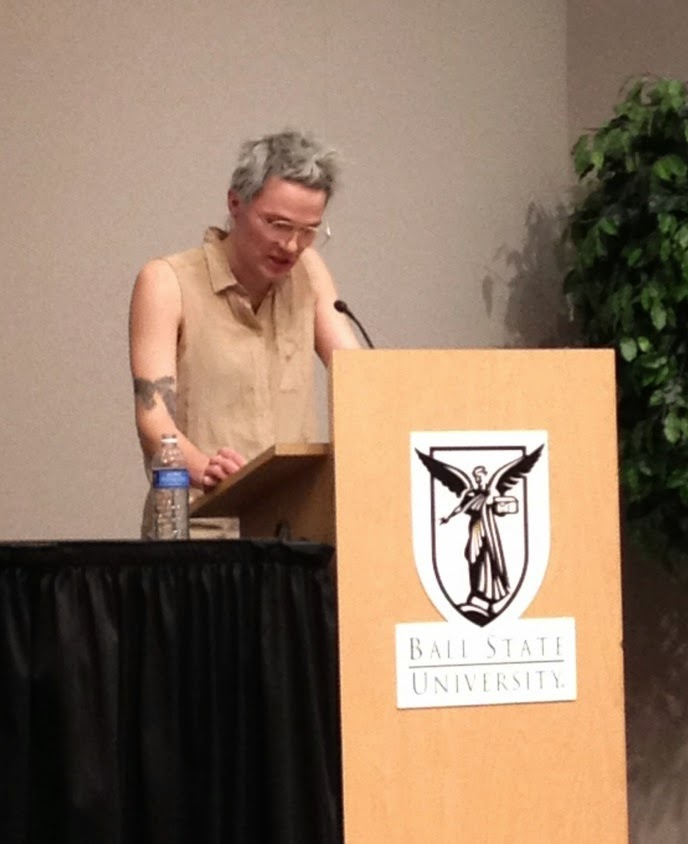
Today was the 9th Annual InPrint Festival of First Books, and I’m so glad I went.  The authors were, as always, absolutely charming and unfalteringly personable.  In the words of T Fleischmann, "Y'all should realize you're really lucky to have this."


Suggested reading: Extremely
Loud and Incredibly Close

Proust, Virginia Woolf
Mario Alberto Zambrano1 read a few cards from Lotería.  Hearing him read is a real treat, as he really lets the voice of Luz, his protagonist, shine through, which makes sense, as it turns out her in-universe writing process mirrors his own process: both drew cards to inspire the next chapter.  He brings out her innocence, making his words feel vulnerable and therefore honest.

"You have to spend a lot of time with this person in your mind, if they don’t respond, be patient.  You have to meet their parents, ask where they came from."

Suggested Reading: The Body,
Times Square Red, Times
Square Blue 
T Fleischmann gave a reading not from Syzygy, Beauty, but from an upcoming work.2  For having a theme of breaking ice was surprisingly warm and fluid, the narrative exploring things taken away and things left behind. Also, they are the second InPrint Nonfiction writer in a row who told Sarabande “Yeah I have a thing almost done” before rushing to finish it.3 The lesson here is to always say you have something ready.

"People will say 'How dare you change this one little thing?' and, I never think each thing is literally true.  To me, pure truth doesn't exist."

Suggested Reading: Black
Aperture, Heart's Needle
Natalie Shapero’s reading may have been my favourite however.  Her voice while reading from No Object (and some new poems!) snaps and crackles, both charming and acerbic all at once, an interesting contrast to her normally bubbly personality.  In response to an audience question she gave the great advice that a writer shouldn’t worry about filling some sort of quota of gendered characters,  an important thing for writers to remember.4 

"An bird screams out my window like an alarm I have set to inform me that a bird is there."

I want to give a lot of props to Robert Stapleton who filled in for Jodee Stanley5 on such short notice and had great advice.  An editor for Booth, my favourite of his advice was “I’m always after the right surprise.”  He doesn’t generally publish things if he knows what’s going to happen, which made sense to me, as I found that my favourite fiction piece from this year’s Broken Plate6 was “Kiss” by Terry Savoie which goes to some strange, unexpected places and it’s awesome.

"I get the sense people don’t know what a story is anymore. A story is about arriving at a place where the world is different than it was in the beginning, the old world has evaporated."

There's something invigorating about a reading, not just hearing words come to life from a book but also about being there, being surrounded by other people who love to read and write.  At a reading, you go for the words but stay for the listeners.  Both are vital in that reminding us that the written world is still alive, still growing.

Oh, and before I forget, props to Brittany Means, Kaiti Crittenden and MaloriePalmer for giving great introductions to the authors. 

Thursday, March 28, 2013

7 Things to Bring when Trying to Get Published

This week my Literary Citizenship class is talking about Publishing A Book, and our challenge is to write what we've learned from our homework. A bunch of it is in the links over here on Literary Citizenship.com, under Publishing a Book 101. Also, check out some of my classmates blogs: Sarah's, Kayla's, John Carter's, Mike'sKiley's, and Lindsey's.  

I keep thinking of the author as a traveler, with different tools in their bag that will help them along the way.  As far as I understand, these are such tools as an Author needs:

1 - The Manuscript and Errata
Your manuscript is important.  Don't send it out until it's ready to be published.  But have offerings for the Agents.  A Proposal, with a synopsis, a query letter, a perfectly polished chapter.  Pluck is great, preparation is better.  Make sure the Agent knows the book's genre and cool factor, how it would appeal to people, who those people are, and be ready to tell an Agent how it ends.

2 - The Grappling Hook
When talking to an Agent, you're not going to get picked at first.  It's like a grappling hook, you can throw it but if you don't find a niche for it to grab it won't hold. That's cool.  Pull it down, aim somewhere else, and throw again.  Eventually you'll find some way to scramble up the cliff face.  It helps if you have something (like the Bishop's Ring, or The Leg) under your belt.

3 - The Bishop's Ring
No matter how good you are as a writer (or in this metaphor, an intrepid detective), it helps to have something to get noticed.  In ye olden days you could show  the bishop's signet ring to someone to make them sit up and take notice.  Nowadays, it's a Namedrop, but it works the same way.  Being able to namedrop someone of note to the Agent will mean you're connected in the web.  The Agent takes interest, you get five more minutes.

4 - The Leg
An Agent wants to be seduced by a proposal.  Show a little leg, just enough to entice.  A paragraph.  Half a page. The less you show, the more the the author will want to know.  As long as it looks good, the rest must be good, and now there is so much more to discover!  Give an Agent too much and they won't have time for it.

5 - Self Awareness
In one of our readings there was an exhaustive Author Questionnaire from Simon and Schuster covering everything from basics (Author's name, address) to inquisitive (religion, business affiliations) to oddly specific (do you shop at Costco's, Sam's, or BJ's?)  I took from this that it's important to know yourself and to be willing to share  your biography.  Also, if you want to publish, now would be a good time to be the sort of person who gets published.

6 - Thy Friends
In my notes I keep writing the reminder, "You are Not Alone."  Not only do you have help publishing (From agents, editors, the various people who work at the publishing house who have the job of advertising) but the people you've known or helped along the way.  Other authors you've supported, fellow students, old friends with connections at that local library.  These are people who can point you to the places you need to go, and can help tell people about your book once it's in the pipeline, or yammer about it on Goodreads.  Related, Goodreads Explained.

7 - The Clouds
Just as a vagabond knows how to watch the clouds for rain, or strong winds, someone getting published should watch The Cloud for trends, emerging markets, new players, lightning flashes that might draw people from all around, where you can share directions, news, helpful herbs.  Right now two big thunderheads are rolling in:  Small Press and Independent Publishing.  Both will blast trees to pieces with a thunderclap, both will enrich the soil and new things will grow, whether or not we want them to.

There's a lot more a person needs. Time, Tenacity, Ingenuity, money helps too.  And as I learned at In-Print last week, the road to publication is rarely straight, there are bound to be lots of twists and curves.  It's more about keeping up with the journey.  


Wednesday, March 20, 2013

In Print Festival of First Books


There’s a silence that comes with writing.  The problem is that so many of us spend so much time trying to find the perfect word, the word made from diamond and moonlight, and put it in its perfect place in its sentence.  But there isn’t that time in the world, so fast and so hungry, to find those perfect words, but we don’t know how not to.  And thus cobwebs form in our throats, little spiders hatched from disuse and imperfection.  So how then do writers tell the world that there is magic happening?
The writers, up close and personal,
so happy to talk to students.  Such
nice people.
With the printed word of course.  Writers will do anything for the sake of words already formed, words already put down.  Writers will walk through snow, into bars we’ve never entered and down streets we’ve never walked to hang posters all over, telling the world “Come, please, there’s magic here, syllables that cascade out of stardust and paint bliss across your ears!” 

This week was the 8th Annual InPrint Festival of 1st Books.   In acquiesce1  to a bit of mandate from Cathy Day I indulged my curiosity to see if our advertisements were worth it.  I went up to the throng of guests asking everyone “Hi!  Why are you here?”2  The first night was a thoroughly dissatisfying commiseration of “I’m here for class, I’m here for class, I’m here for Cathy Day’s 307, I’m here for my 104, I’m here because I need to graduate and this requires no commitment.”

A few though, like Brett, whose hair is still not grown back from when he cut it early this year, came because they “Just like these things” and by heaven it was a relief, he was the first who came just to come.  There were more like him, more literary citizens, quiet but present, fluttering like moths to the fires of their choosing.3   There were another smattering who came for The Broken Plate,4 which came wearing its new wine dark lipstick of a publication, skirt pulled back, ankle bare, and it was a buffer, a book-end, its table opposite the writers as if to say “This place between word and sound is for you, you have come into the garden.  Here you are safe."

"If you go on this...pilgrimage to Prairie Lights, they will
BUY YOU COFFEE AND CRUMPETS." 
And the writers were magnificent.  That first night there was Elena Passarello, who made us laugh and smile as she transfixed us with a dead woman’s voice.  There was Marcus Wicker, whose poems had punch line titles and punch gut conclusions.  There was Eugene Cross, whose smile is a giddy puppy and whose writing is vivid and sharp and sad, maybe the saddest thing5 I’ve read in months. 

The audience raised spirits the second day.  While the first night was a “The Place was packed” sort of night, now on the second night it had dropped to just “A lot of people came.”6   BUT, the people who did come had less of this “I’m here for class,” more of this “I’m here for fun” OR “I’m here for Extra Credit” which is important because they still CHOSE to come, AND people who come for extra credit care enough about the thing for that credit.  They care, they just don’t know how to show it yet.  And then of course there were those who came because they wanted to support the poets, who’d been to every InPrint Festival since its inception, who praised the group’s dynamic and the advertisements that they’d seen, and I swelled with pride that someone, anyone, had noticed the work.

That happy moment when more people came back because they chose to.
The panel of the three writers who read the night before was joined by Sarah M Wells, an editor with a snappy personality who's somehow still alive despite doing everything in the world; writing, publishing, editing, mothering.  A human thunderstorm.  Their answers to questions showed me something vital: That Abyss between us and Published Writers is not so vast, is a matter of words.  They are not gods, or if they are, so too someday might we be.  Audience members praised their dynamic, the excitement and honesty of them, the way they made the room come alive.

Everyone wanted an autographed book and every author was so delighted to talk to people that we ran delightfully over time and had to be hurried out by the management. 
The conversation that had the most resonance to me was with Guy With Camera, who’d filmed the whole thing for a TCOM class.  I asked him, “What brings you here?” and he said that he was here for a class, “but I do some writing too”.  There was some defensiveness in it, but also some aspiration, some acknowledgement that here, in this room, books and writing are the hippest things imaginable.  It made me smile, let me clear my throat7 of the last of the cobwebs, let me rave and ramble about all this to my roommates when I got home, with no fear of imperfect words because there were enough of those today to last a lifetime.