Friday, May 30, 2014

What to learn about Exposition from Skin Game: A Novel of the Dresden Files

Preface: I’m not gonna say much about the quality of Skin Game: A Novel of the Dresden Files by Jim Butcher. Of course it was phenomenal. Butcher always brings the goods. If you like Urban Fantasy, you need The Dresden Files. But given that the book came out 3 days ago and there are already over 200 reviews, once again I’m not needed to help sell this one either.1  So instead, I’ll use it as an example of how to do exposition right. 
.

Warning: From here it’s spoilers all the way down.

Butcher is a master of exposition. We’re fifteen novels into this series and his fantasy ‘verse is VAST.2  Butcher views world mythology like a giant treasure vault that he’s got the keys to, so pretty much anything can show up. 3 As this book brought back a lot of old characters for a big multiplayer heist narrative (They knock over the Vault of Hades. It takes like three days because Harry’s a badass.) Butcher was free to bring a lot of past stuff in.

One thing he brought in was The Genowska, one of the Forest People. Now, I’m an avid reader, but I didn’t remember them at all. I was wondering if I’d missed a book, and it turns out I had. The Forest People were introduced in a short story published in an obscure anthology I haven’t read.4 However, because Butcher is a master of exposition, he managed it subtly.

(Presumably the Zombie T-Rex has it?)
We’re introduced to The Genowska subtly. In the abandoned slaughterhouse being used as a base there’s a pen containing eleven goats.
Then ten.
Then eight.

Something’s eating them, one at each meal. We get about 170 pages to worry about what terrible, invisible monster Dresden’s employer is feeding. Dresden, being tactful as a jar of live bees, gets tired of being in the dark.

“Whatever big, ugly, stinking, stupid thing you've got hanging around in here with us probably doesn't deserve to be in this company. Given our goal, I don’t see the point in taking along a mindless mound of muscle.”

But then the Genowska removes its veil. We get a good paragraph of description of a big, hulking thing, like the side of a mountain, growling at Dresden’s rudeness. But it’s not the size, or the growl, or the eyes “glinting like an assassin’s knives from a cave’s mouth.” It’s that Dresden stops being a wiseass.

“An ogre?” Ascher asked. 
“Not an ogre,” I replied immediately.5 “He’s one of the Forest People.”

Dresden then launches into a description of a Forest Person tearing through “about twenty ghouls in a fair fight.” However, note the technique: Butcher doesn’t just tell us that the thing mighty, but gives us an example of exactly how mighty. We’ve seen Dresden struggle with just three ghouls a few chapters back, so this is an impressive juxtaposition.

To reinforce that he’s worried enough about this thing to be respectful, he apologizes to it. “Sorry about what I said earlier. I figured [my employer] had a troll stashed around here somewhere. Didn’t realize it was one of the Forest People. I’ve done a little business with River Shoulders in the past. Maybe you’ve heard of–”

And then the Genowska punches Dresden across the room.

"The Ice that should have entombed him just...drained away..."
“Consider this a friendly warning. I am not one of the whimpering Forest People. Speak of me and that flower-chewing groundhog lover River Shoulders in the same breath again, and I will devour your offal while you watch.”

This is what's called “The Worf Effect.” When you have something badass, if something else beats that thing up it proves how dangerous it is. Here we have the Genowska calling something that can tear through a score of Ghouls “Whimpering” and “flower-chewing.”

And thus we have a dangerous and powerful foe established, juxtaposed against characters the reader hasn’t met (if they didn’t know about the short story, like me) and a mythology built up around them, all done through a single scene that builds on a history that, for all I knew, could have been only in the author’s head, but I still understood all of it.
The "Dean of contemporary
urban fantasy." – Booklist

In this single scene, we learn enough a suitable amount about

  • The Forest People 
  • How dangerous they are 
  • The Genowska 
  • How much more dangerous he is

To review, Butcher built up this monster by

  • Hinting at its presence several times 
  • Revealing it visually 
  • Showing how a character reacts to it, to give context 
  • Gives it an action and a line of dialogue

At no point does the book flat out say “The Genowska is dangerous.” We learn that through action.

Exposition can very easily bog down a book, especially a fantasy book. The lesson here is that when introducing something important to the novel, give it its own scene, show how it interacts with the world in action, as opposed to exposition.

If you want to learn more about how to write good fantasy, go pick up these books. It’s one of he best choices an aspiring fantasy author can make.

This isn't really related to writing, I just wanted to remind everyone that
this is canonically part of the Dresden Files now.

Tuesday, May 27, 2014

Who Needs Neopagan Rites by Isaac Bonewits?

"That which is
remembered lives."


I’ll start by saying that Neopagan Rites: A Guide to Creating Public Rituals that Work is an excellent book. It doesn’t surprise me that so many of my pagan friends have copies, shared around to the point where people have lost track of whose book is whose. Written by the late Isaac Bonewits1 it is enlightening and well researched, benefiting from Bonewits longstanding importance in the community and years of writing liturgy. Exploring all the considerations necessary for creating Neopagan Liturgy, it manages to be an enjoyable read even in the slower sections, crackling with wit.
  
 "…you may be forced to have paper cups and plates on hand, but for Goddess’ sake, have them at least look dignified.  Using Styrofoam is probably a sin."
  
 This book doesn’t need my help to be read2, so instead of praising it, I’m going to give a bit of advice for potential readers.

This book is not for everyone. Somewhat light on examples, it assumes a certain familiarity with Neopagan ritual, especially group ritual, and a knowledge of some of the history of Neopaganism and magic. I would not advise this book if
  • You are only just starting out on a Neopagan path3 
  • You live in an area without an active pagan group 
  • You aren’t ready to take part in the Neopagan Clergy 
  • You have never participated in a public/large group Neopagan Rite 
  • You are easily offended by occasional jibes at Christianity4
"The Gods are watching us, so let's give them a good show!"
I would advise this book if
  • You are or plan to start leading group pagan rites, especially public ones 
  • You have practice with Neopagan rites and think you know what you’re doing5 
  • Your local Neopagan group needs to spice up its liturgy/shake up traditionalism 
  • You have a solid grasp of Neopagan theology/thealogy6 and history 
  • You want a valuable addition to any Neopagan library, personal or group 
Or, and this is the biggest reason: You don’t have any experience. You’ve only got a handful of other Neopagans in your area. You’ve got no leaders, no practice, no real unity, but you want them. An important aspect (often overlooked) that Bonewits stresses is for a ritual to include a reminder of continuity with rituals of the past and the future. This book provides that. It carries the feeling of growth, of little rituals building to big ones, faith groups that should flounder managing to soar. If you’re going to start from scratch, this may be the best place to start. If you’ve got nothing to go on, just pluck and sincerity, this will at least provide you with some sort of ground to stand on.7

"Remember that if you do a fall equinox rite at sunset, you will probably not be able
to get the sun to delay setting while latecomers straggle in."

Tuesday, May 13, 2014

Syzygy, Beauty, by T Fleischmann - Review


My friend recently finished Dark Lord of Derkholm.1 When she gave it back to me, I darted upstairs to fetch Year of the Griffin2 for her, and she told me “I don’t think I’ll be able to get to it until the end of the Summer, is that okay?” I pshaw’d3 and told her not to worry, “I almost never reread books.”

 T Fleischmann’s essay Syzygy, Beauty, the second nonfiction book from Sarabande that I’ve reviewed, is a rare exception. In the picture above is one of my favourite quotes, and when I was first making it, it was only going to read "I have been so many places I must be sunlight. Listen, I have been diffused by clouds, by everyone who has touched me."4  But when I went back to check I hadn’t messed it up, I read the last bit, and understood the subtlety of being "destined for the earth."5 The whole book is like that, every time I thumb through it I learn something new.

"Your boyfriend is an atmosphere, there before
me and remaining to sustain you now."
Half art-critique and half meditative memoir over a series of relationships, Syzygy, Beauty explores art, gender, love, travel, loneliness, and a wide variety of other subjects. Fleischmann’s relationship with the omnipresent but never truly defined "You" feels both intense and ephemeral, the "You" always at arm’s length even in intimate moments, occulted6 by their lack of name and their other boyfriend(s) who often seem to eclipse the narrator. Intriguingly, when asked,7 Fleischmann said that "You" was not a single person, but an amalgamation of a variety of similar relationships. "If I ever said something bad about 'You', I could always say 'Oh no, that wasn’t you, it was the other one'"

 This hits at the core of why I love this book, and what it represents, the untruthing of the nonfiction genre. It’s easy to assume that nonfiction must succumb to what Esther Wolfe once called "The fetishization of reality" but Syzygy, Beauty deconstructs the ideas of reality and truth. While it may not tell the True-True or the Whole-True,8 it still tells truth, possibly more truth than it could tell if bound by reality. Fleischmann, in this book, is blurring the lines of reality and fact, the result being somewhere in-between.

"Keep kissing me, you'll see,
new houses aren't haunted yet."
This works remarkably well with many themes of the novel, whose narrator always seems to be in a state of transience. Between lovers, between city and nature, between boy and girl, the narrator always seems most 9 However, while the essay complicates ideas of gender and beauty and place, it never offers real closure. Most pages will open and close with a sentence about, say, Grayson Perry or Louise Bourgeois, juxtaposed with a body of narrative in-between.10 The reader is presented with ideas and left to make their own meanings, which might be the most nonfictional thing in the world.
happy in the middle, where what all of those things mean can be complicated. “When you held my arms to the bed, I felt like a femme fatale who could swing a hammer…”

A fantastic and emotional read, I've been slow to review it only beacuse I've been throwing it at everyone I know.  I think a lot of people could benefit from this book, especially people encountering this brave new world, that has such non-binary gender ideas in it.
"Even God can't really say what something is without burning stars."

Thursday, March 20, 2014

InPrint Festival of First Books 2014

Today was the 9th Annual InPrint Festival of First Books, and I’m so glad I went.  The authors were, as always, absolutely charming and unfalteringly personable.  In the words of T Fleischmann, "Y'all should realize you're really lucky to have this."


Suggested reading: Extremely
Loud and Incredibly Close

Proust, Virginia Woolf
Mario Alberto Zambrano1 read a few cards from Lotería.  Hearing him read is a real treat, as he really lets the voice of Luz, his protagonist, shine through, which makes sense, as it turns out her in-universe writing process mirrors his own process: both drew cards to inspire the next chapter.  He brings out her innocence, making his words feel vulnerable and therefore honest.

"You have to spend a lot of time with this person in your mind, if they don’t respond, be patient.  You have to meet their parents, ask where they came from."

Suggested Reading: The Body,
Times Square Red, Times
Square Blue 
T Fleischmann gave a reading not from Syzygy, Beauty, but from an upcoming work.2  For having a theme of breaking ice was surprisingly warm and fluid, the narrative exploring things taken away and things left behind. Also, they are the second InPrint Nonfiction writer in a row who told Sarabande “Yeah I have a thing almost done” before rushing to finish it.3 The lesson here is to always say you have something ready.

"People will say 'How dare you change this one little thing?' and, I never think each thing is literally true.  To me, pure truth doesn't exist."

Suggested Reading: Black
Aperture, Heart's Needle
Natalie Shapero’s reading may have been my favourite however.  Her voice while reading from No Object (and some new poems!) snaps and crackles, both charming and acerbic all at once, an interesting contrast to her normally bubbly personality.  In response to an audience question she gave the great advice that a writer shouldn’t worry about filling some sort of quota of gendered characters,  an important thing for writers to remember.4 

"An bird screams out my window like an alarm I have set to inform me that a bird is there."

I want to give a lot of props to Robert Stapleton who filled in for Jodee Stanley5 on such short notice and had great advice.  An editor for Booth, my favourite of his advice was “I’m always after the right surprise.”  He doesn’t generally publish things if he knows what’s going to happen, which made sense to me, as I found that my favourite fiction piece from this year’s Broken Plate6 was “Kiss” by Terry Savoie which goes to some strange, unexpected places and it’s awesome.

"I get the sense people don’t know what a story is anymore. A story is about arriving at a place where the world is different than it was in the beginning, the old world has evaporated."

There's something invigorating about a reading, not just hearing words come to life from a book but also about being there, being surrounded by other people who love to read and write.  At a reading, you go for the words but stay for the listeners.  Both are vital in that reminding us that the written world is still alive, still growing.

Oh, and before I forget, props to Brittany Means, Kaiti Crittenden and MaloriePalmer for giving great introductions to the authors. 

Wednesday, August 21, 2013

Three Reasons "I, Robot" is good for modern readers

This picture is entirely unrelated.
During class introductions I said I liked Fantasy/Sci-Fi, only to be accosted by my classmates for having never read any Asimov.  I was jokingly tasked with reading I, Robot and bringing in a book report by the next class.  So I did.1  My report, which I’m putting up here, highlights three2 reasons I think I, Robot would be a good read for modern readers.

Firstly, Humor.  There is a conception in much of modern science fiction of grit.  This is demonstrated primarily in the videogame genre, which features protagonists with such broad shoulders and stubbly faces that they make Jake Gittes look soft-boiled.  The protagonists of I, Robot are no such macho-men, instead they are primarily scientists and technicians who given an impression of early baldness and pocket-protectors.  Geeks.

Donovan and Powell, in their other job arranging
spring break activities for College Kids.
But they’re fun, loveable geeks.  To me, the muscle gods of Gears of War are just as Alien as the Locust they fight.3 But the protagonists, especially Powell and Donovan, who are ALWAYS the ones that get the short end of the stick as far as Malfunctioning Robot Shenanigans go, and their world-weary attitudes towards these Shenanigans make them delightfully relatable, both to the kid whose user mod for League of Legends won’t render right to the office worker who can’t get Microsoft Excel to behave.

Secondly, right now people love a Strong Female CharacterTM, but more even than that they love arguing over whether or not someone qualifies as a Strong Female CharacterTM.  Susan Calvin, the other primary protagonist for most of the book and arguably the most prominent character, is clever, quick-witted, and doesn’t rely on men to get things done, but at the same time the only chapter which has her showcasing strong emotions has her tearful over lost love. 

I am by no means a Gender Studies expert4 , and so I won’t comment on whether Susan Calvin is or is not a good feminist role model.  Whatever else she is, she is an extremely compelling character, and watching her cleverly deduce the problems with robots, especially ahead of the men in her field, is highly satisfying.  The book reads just as much like mystery as it does Sci-Fi.5 

However, a third issue I find prescient is the issue of Religion.  In Chapter 3, “Cutie”6, a Robot who is meant to be running a power converter, goes a bit rogue, developing a Cult of the Master and teaching other Robots to join in as well.  This leads to trouble for, of course, Powell and Donovan. 
To be fair, I too would assume that Powell and Donovan couldn't be my
makers due to their inferior intelligence.

The Clerical Fiction is of course delightful, but what I find interesting is that in the text you could interpret either side as being Theist/Nontheist in the debate, which resembles many that go on between Theists and Nontheists today.  Cutie appears to be the “Religious” one, given that he is “The Prophet of the Master”, he also resembles a Militant Atheist7  in his utter refusal to accept anything on faith, such as the existence of Earth.  I think in the end, the story is more of a caution against radical religiosity than any particular side of Theist/Nontheist view.

I, Robot is a satisfying read, start to finish, and definitely worth checking out.  For those not into Science Fiction, don’t worry, most of the stories revolve around characters solving Logical and Philosophical problems than figuring out some way to reverse the polarity of the neutron flow.  It’s top quality Sci-Fi.  Go grab it.
"[You could not have made me]. I mean, look at you!  Periodically
 you pass into a coma and the least variation in temperature, air pressure,
 humidity or radiation intensity impairs your efficiency.  You are makeshift."

Thursday, August 1, 2013

Hook & Jill by Andrea Jones - Review

There are spoilers, highlight to view!

"For one long moment, she held hope in her hand.  Then,
like sunlight, peter slipped through her fingers."
After a lazy summer I'm back to blogging and Book Reviewing!  Today it's Hook & Jill, by Andrea Jones, first in the Hook & Jill Saga.  The story is an adult interpretation of Sir James M. Barrie's Peter Pan stories, taking liberties with the source material1 in order to explore themes of emerging sexuality and desire, with the story mostly told from Hook's perspective.  The story's convolutions and complications of  Hook and Wendy's near DeathNote level gambits are fun to watch as they unfold and unravel.  Equally fascinating are the complexities of morality presented.

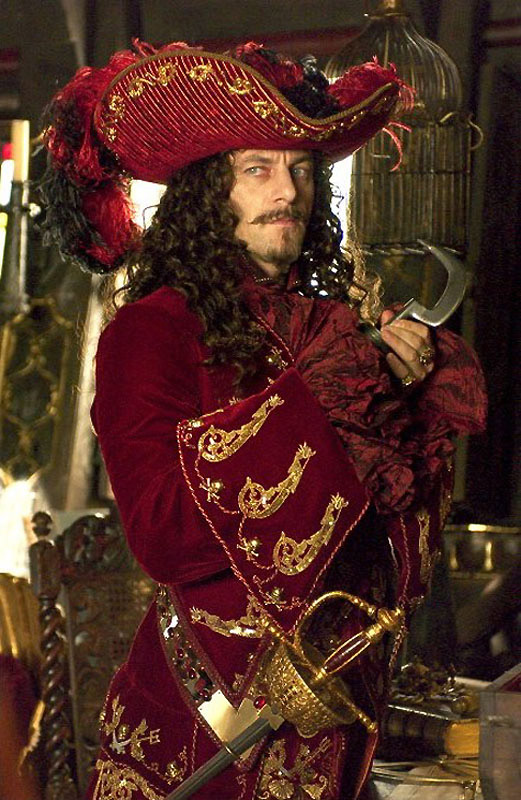
Jason Isaac's Hook is closest to
Book Hook, but I think we can all
agree that Dustin Hoffman's
Hook from Hook is Best Hook.
Hook is a bad man, there's no real denying that, but so too is Peter.  Peter was terrifying.  Sure, he's happy-go-lucky and puckish, but he holds an aura of menace over the Lost Boys that gives you a feeling of constant danger whenever he's around.  His puckishness gives the impression that he could snap at any moment, and his border-line control freak personality creates an impressive threat.

Meanwhile, Wendy's sexuality is turned up a bit.  In the novel, the children are aging, and Wendy's hitting puberty like a chevy slamming into a brick wall.  We get this repeated image of "A kiss sitting on the edge of her mouth" that functions as an effective McGuffin throughout the story.2

The language is rather interesting in the novel as well.  Many characters are referred to by monikers as much as their real name.3 "The Golden Boy" or "The Italian Sailor."  It's a welcome change, it keeps the book from getting to repetitive as different characters take the stage with increasing rapidity.  There are also some fantastic bits of wordplay, for instance, Captain Hook contemplates Wendy thusly:

"Pluck. And abandon. Exactly the traits he required of her. He nodded to himself. Exactly the things he would do to her."4

That line makes me shiver5 with how good it is.  The book is a wild ride, especially towards the end, after Wendy dies, Slightly and his boyfriend6 discover Pan's darkest secret7, Spoilers, and the Crocodile gets sprinkled with Fairy Dust.  I will admit that as things get a little chaotic it can be a little hard to tell what's going on, but then again I was somewhat sleep deprived after #mww13.  Also, the last full chapter, "Seas of London" must have been written under the influence of the Mead of Poetry or something, because it simply sings.  I could almost smell the Chimney Smoke and hear the tinkle of the Kensignton Garden Fairies.  If you're a fan of fairytale or women's coming of age lit, I'd definitely grab this book.  I'll probably pick up the sequel.

"Disarming women was his forte. One only had to identify their weapon and use it first."
Oh!  And did I mention I actually got to meet Andrea Jones at the Enchanted Lakes Renaissance Faire? She signed my book!  I love signed books!


Saturday, June 8, 2013

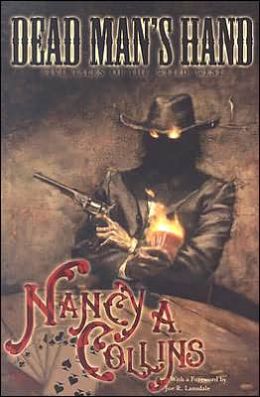
Dead Man's Hand by Nancy A. Collins - Review

Now that Mono is done punching me in the throat1 I've had a chance to enjoy a book!

Dead Man's Hand by Nancy A. Collins is a series of Weird West2 stories that, by and large, deal with all the classic Western themes:  Freedom, guilt, revenge, duty, and questions of allegiance.  The book contains five stories (three medium length and two shorts) that exist mostly independently, thus I'll review them all on their own before talking about the book.

Also, as the book is published by a subsidiary of White Wolf, who make the World of Darkness games, I've sorted into different White Wolf Gamelines.3

Hell Come Sundown (Vampire: The Requiem) - A Texas Ranger turned monster-hunter named Sam Hell deals with a Vampire Conquistador who wants to start his own empire of the dead.

This is a great way to start the book, as it goes into the existence of various beasties so that you know what kind of universe this is taking place in.  Two parts really stick out to me, the opening where a boy is menaced by something from under the bed, and later, a man in the one church in Golgotha4 tells the story of how the town fell.  Both are creepy and draw you in, the way any good ghost story should.

The story as a whole is generally good, full of nice set pieces, although I found some sections a little more Hollywood than Deadwood.  Still, the Vampire Conquistador is cool and I haven't really seen that before.  A solid opening.  

I forgot to mention, there's a cannibal horse.
It's awesome.
Lynch (Promethean: The Created) - Johnny Pearl, a man with a history of violence and a pearl-handled gun5 that whispers wicked words into his ear tries to remake his life only to wind up lynched and brought back from the dead by one of Viktor Frankenstein's old accomplices.

This is my favorite of the longer stories, tied for favorite story in the book.  Pearl/Lynch is a delightful character, as is Mirablis, our Not!Frankenstein for the evening.  The explorations of how Frankenstein's experiments interact with the West is fantastic, especially Sasquatch, a flesh golem made from most of a tribe of Native Americans.6  His spotlight chapter exploring what it all means is amazing.

The whole story has this very satisfying feeling of all the ends of a very disparate book being tied together very well, and has some excellent moments that really make use of the setting and the character's strange natures.  Best of the three longer stories.  

Woof woof.
Walking Wolf (Werewolf: The Apocalypse) - Walking Wolf, a Werewolf from the Old Country raised by the Comanche has a shitty life, and then it sucks to be a Native in Post-Civil War America, and then everyone dies.  Also, Racism.  Everywhere.7

This for me was the weakest of the short stories.   It has this good premise of Werewolves being immortal, meaning the story is being written by someone in our time looking back on history.  While the history of the fall of the Indigenous Tribes is interesting the story spends a long time on it and somewhat looses its thread, and I'll admit I spent parts of this story not knowing where it was going.  However, the mythology is well thought out8 and the various strange things that the white folk do were just weird enough to be based on real history.  Like the man with a harem who cut out his wives tongues, so they invented a strange, hissing language.

An interesting story that probably deserves more examination by people who know more about race and history, though I think it would have been stronger if it had been tightened up a little bit.  

Man this needs a cooler
cover.
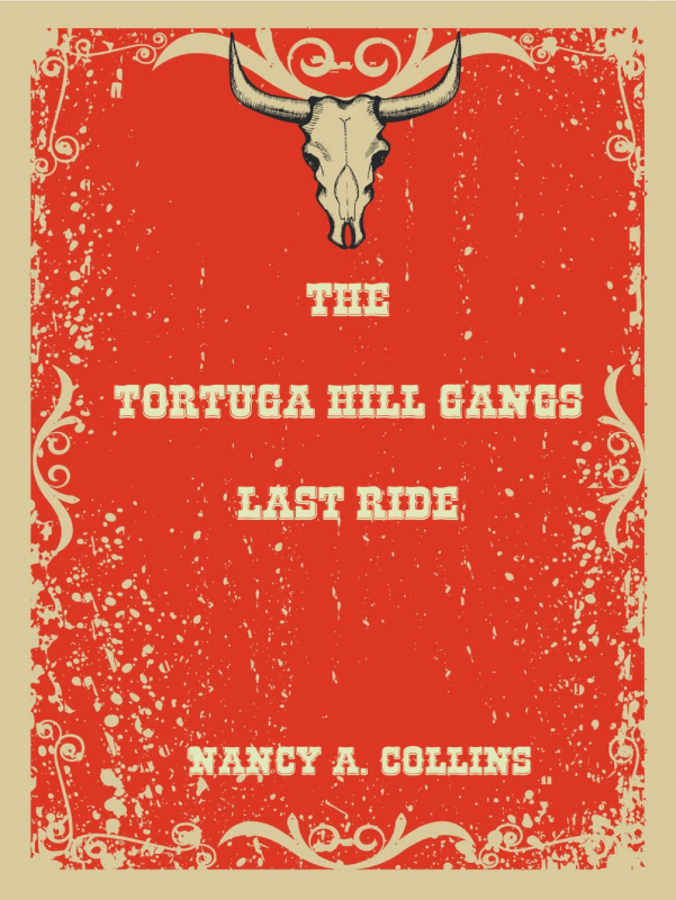
The Tortuga Hill Gang's Last Ride (Changeling: The Lost) - Everything goes south for a gang of outlaws when they let a simpleton with strange powers into their gang.

This is my favorite of the two shorter stories.  The characters are all unique and strong, and I really like the way we get into the different outlaw's heads despite only having about 20 pages with them.  Little Red, the Sidhe outlaw, is a very dangerous being, but you really pity him as more conniving characters take advantage of him.  I'll probably steal him9 for a story one of these days.  The shortness and the troperific nature of the story makes it a good little campfire read, and I'd love to see it done as a longer story at Sundance.

A marvelous little read.  My only complaint is that there isn't more of it.  You can get the whole thing for only two bucks right here, which I'd advise everyone to do.  

This one needs a cover at all.
Calaverada (Geist: The Sin-Eaters) - A Gang of bounty hunters chases a man into Mexico, but it's a bad idea to kill a man on The Day of The Dead...

This story is quite short, so it's hard to say much about it.  I do quite like how vivid the author makes Dia de los Muertes.  The characters here are some of the stronger characters, despite having so few pages devoted to them, and while their eventual fate was, perhaps, a tad predictable, I still think it was carried out very well.  It also feels a bit like one of Aesop's Fables, only with gunslingers and ghosts!

Not bad, and again I'd like more, maybe with a bit more mystery or surprises.  

There's my final roundup.  I enjoyed the book and would recommend it to any fans of the Weird Western.  All of the stories but Calaverada are available online, so at the very least go grab Lynch and The Tortuga Hill Gang's Last Ride.
The most Weird-Western image you could
possibly have. 


If you're interested in other Weird West stories, check out Six-Gun Tarot as well!